Global Blue Tansy Oil
Market Report 2019–2029
Comprehensive analysis of production, pricing, trade flows, competitive landscape, and a 5-year market forecast — sourced by your wholesale essential oil experts.
Table of Contents
Blue Tansy Oil Market Overview
1.1 Product Overview
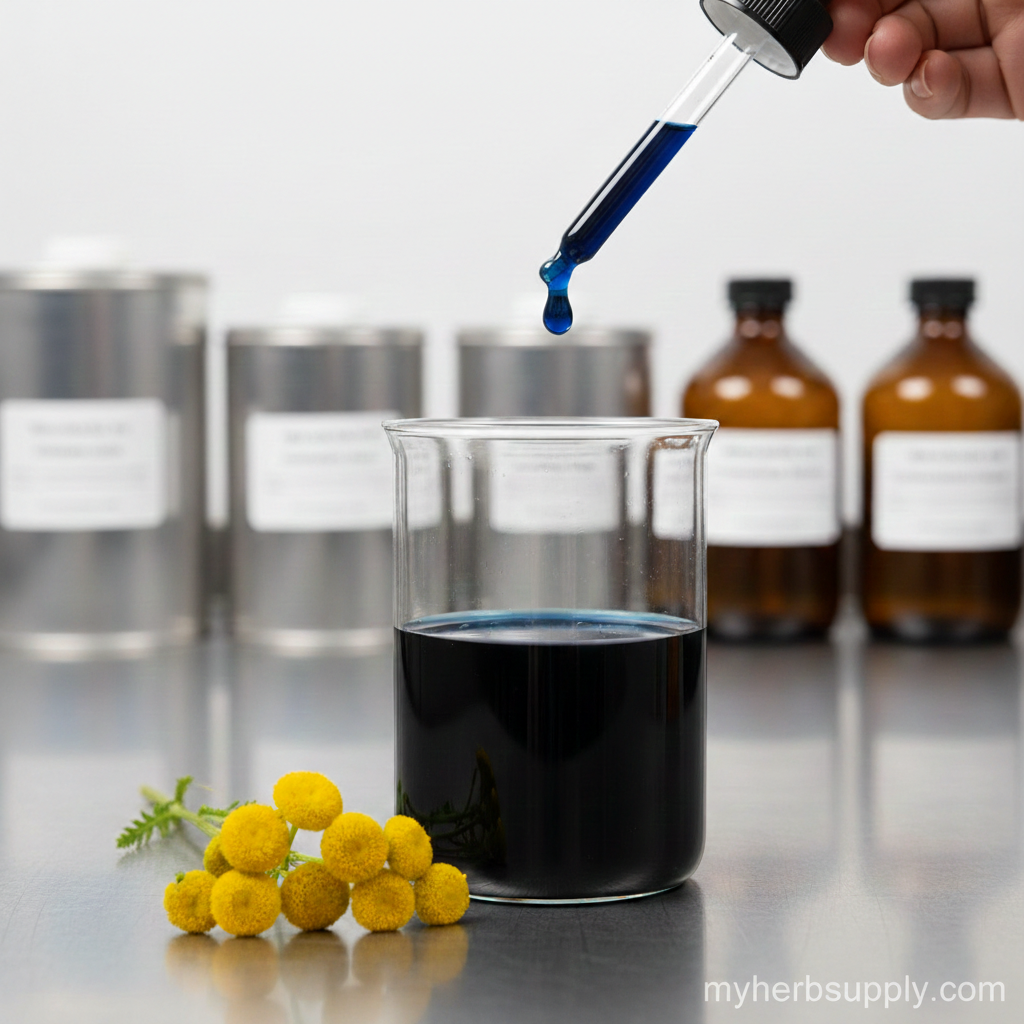
Blue tansy oil is a premium essential oil steam-distilled from the flowering tops and leaves of Tanacetum annuum, an annual herbaceous plant native to Morocco and parts of the western Mediterranean region. The oil is prized for its intense, deep-blue color — a result of chamazulene formation during steam distillation, where matricine in the plant is converted to this vivid chromophore.
The primary active constituent is chamazulene (typically 5–30% of composition), contributing both the characteristic color and anti-inflammatory activity. Additional key constituents include camphor (15–35%), sabinene, myrcene, and beta-pinene. Blue tansy oil is typically priced between USD 150–400/kg at wholesale, making it one of the highest-value commercial essential oils.
1.2 Market Segmentation
By Grade
- Therapeutic / High-Chamazulene (>15%): Premium segment; preferred by clinical aromatherapy practitioners and luxury skincare brands (~38% market share).
- Standard Commercial Grade (5–15%): Largest volume segment for personal care formulations and aromatherapy (~47%).
- Industrial / Blending Grade (<5%): Fragrance blending and bulk personal care; lowest price point (~15%).
By Application
- Luxury Skincare & Cosmetics — largest and fastest-growing segment
- Aromatherapy & Wellness — strong established demand
- Natural Anti-Inflammatory Topicals & Serums — high-growth specialty
- Hair Care Formulations — scalp soothing trend
- Pharmaceutical / Nutraceutical — emerging, research-driven
- Fragrance Blending — niche herbaceous-camphoraceous use
1.3 Regional Market Overview
| Region | 2024 Share | Key Driver |
|---|---|---|
| North America | ~34% | Natural skincare boom, DTC brands, influencer marketing |
| Europe | ~27% | Premium cosmetics, F&F industry, sustainability mandates |
| Asia-Pacific | ~18% | K-beauty influence, China luxury skincare, Australia naturals |
| Middle East & Africa | ~16% | Primary production (Morocco), nascent domestic demand |
| Latin America | ~5% | Brazil & Mexico natural beauty growth |
1.4 Market Dynamics
Key Drivers
- Social media-driven discovery: Blue tansy’s vivid blue color is a viral phenomenon on Instagram, TikTok, and YouTube.
- Clean beauty movement: Global shift to natural, plant-derived skincare ingredients is structurally favorable across all markets.
- Anti-inflammatory skincare trend: Growing demand for calming and anti-redness solutions elevates chamazulene-rich oils.
- K-beauty influence: South Korean beauty innovation drives global adoption.
- Premium wellness spending: Post-pandemic investment in personal wellness continues expanding the addressable market.
Key Restraints
- Extreme supply concentration: ~85% of global supply originates from Morocco.
- Adulteration risk: High prices incentivize fraud; GC/MS verification is essential.
- Limited cultivation: Primarily wild-harvested, constraining supply expansion.
- High price point: USD 150–400/kg limits mass-market formulation penetration.
1.5 Industry Policies & News
- EU Cosmetics Regulation 1223/2009 requires camphor-containing products above 0.5% to carry specific labeling.
- Morocco’s ONCA launched a Tanacetum annuum cultivation program targeting 500 cultivated hectares by 2027.
- Several US brands received FDA warning letters (2022–2023) for unapproved anti-inflammatory health claims on blue tansy products.
- IFRA reaffirmed camphor usage restrictions in leave-on cosmetics; formulators must monitor concentration limits carefully.
Industry Chain Analysis
2.1 Upstream Raw Material Suppliers
Tanacetum annuum grows natively in Morocco’s pre-Saharan and semi-arid zones — particularly Fès-Meknès, Oriental, and Drâa-Tafilalet regions. The plant is predominantly wild-harvested in summer (June–August) when chamazulene precursor content peaks. A fresh herb-to-oil yield of approximately 0.2–0.5% is typical, meaning 200–500 kg of plant material yields just 1 kg of oil — one of the lowest yields among major commercial essential oils, which fundamentally drives high pricing.
2.2 Major Industry Players
| Company | HQ | Primary Role | Key Segment |
|---|---|---|---|
| Florihana Distillerie | France | Producer / Exporter | High-grade therapeutic & cosmetic |
| Plant Therapy Essential Oils | USA | Brand / Distributor | Retail aromatherapy |
| Moroccan Natural Distillers | Morocco | Producer / Exporter | Bulk wholesale |
| Rocky Mountain Oils | USA | Brand / Distributor | DTC aromatherapy |
| Osea Malibu | USA | Skincare Brand | Luxury skincare |
| Herbivore Botanicals | USA | Skincare Brand | Clean beauty / DTC |
| Sunday Riley | USA | Luxury Skincare | High-end serum products |
| Jedwards International | USA | Specialty Ingredients Trader | B2B industrial |
2.3 Production Process
- Wild Harvesting: Flowering aerial parts harvested by hand at peak bloom. Timing is critical — early harvest yields lower chamazulene.
- Wilting: Material spread in shade 12–24 hours to reduce moisture and improve distillation efficiency.
- Steam Distillation: Plant loaded into copper or stainless-steel stills. Matricine converts to chamazulene (deep blue) under steam heat.
- Condensation & Separation: Vapor condensed; essential oil floats and is separated from the hydrosol by decantation or centrifuge.
- Quality Analysis: GC/MS testing verifies chamazulene content, camphor levels, and absence of adulterants. Batch CoA generated.
- Export: Packaged in dark glass or nitrogen-purged stainless containers; refrigerated storage; exported via Casablanca.
2.4 Cost Structure (Mid-Scale Moroccan Distiller)
| Cost Component | Share (%) |
|---|---|
| Raw Material (wild-harvested herb, labor) | 48% |
| Labor (distillation, processing, QC) | 15% |
| Energy (distillation fuel/electricity) | 14% |
| Overheads (equipment, facility) | 10% |
| Quality Control, Certification & Export Docs | 8% |
| Packaging (dark glass, nitrogen purge) | 3% |
| Other / Miscellaneous | 2% |
Ex-works production cost ranges from USD 90–160/kg (standard grade) to USD 140–230/kg (therapeutic grade). Certified organic adds a further 35–50% cost premium.
Value Analysis, Production, Growth Rate & Price by Type
3.1 Global Production by Type (Metric Tons, 2019–2024)
| Year | Therapeutic (MT) | Standard (MT) | Industrial (MT) | Total (MT) | YoY Growth |
|---|---|---|---|---|---|
| 2019 | 8.2 | 10.6 | 3.2 | 22.0 | — |
| 2020 | 7.8 | 10.0 | 3.0 | 20.8 | -5.5% |
| 2021 | 9.1 | 11.8 | 3.5 | 24.4 | +17.3% |
| 2022 | 10.4 | 13.2 | 4.0 | 27.6 | +13.1% |
| 2023 | 11.8 | 14.9 | 4.4 | 31.1 | +12.7% |
| 2024e | 13.2 | 16.6 | 4.8 | 34.6 | +11.3% |
Global production reached an estimated 34.6 metric tons in 2024, a CAGR of ~9.5% from 2019–2024. The 2020 decline reflects COVID-19 disruptions to wild-harvester mobilization in Morocco during the critical June–August harvest window.
3.2 Market Value by Type (USD Million)
| Year | Therapeutic | Standard | Industrial | Total (USD M) |
|---|---|---|---|---|
| 2019 | $4.6M | $4.0M | $0.9M | $9.5M |
| 2020 | $4.4M | $3.8M | $0.8M | $9.0M |
| 2021 | $5.5M | $4.7M | $1.0M | $11.2M |
| 2022 | $7.0M | $5.7M | $1.2M | $13.9M |
| 2023 | $8.7M | $6.9M | $1.3M | $16.9M |
| 2024e | $10.5M | $8.0M | $1.5M | $20.0M |
3.3 Average Wholesale Price by Type (USD/kg)
| Year | Therapeutic | Standard | Industrial | Organic Premium |
|---|---|---|---|---|
| 2019 | $156/kg | $105/kg | $78/kg | $220/kg |
| 2020 | $158/kg | $106/kg | $79/kg | $224/kg |
| 2021 | $168/kg | $111/kg | $83/kg | $238/kg |
| 2022 | $188/kg | $121/kg | $88/kg | $265/kg |
| 2023 | $206/kg | $130/kg | $94/kg | $292/kg |
| 2024e | $220/kg | $138/kg | $98/kg | $315/kg |
Downstream Characteristics & Consumption by Application
4.1 Consumption by Application (2024e)
| Application | Volume 2024 (MT) | Market Share | CAGR 2019–2024 |
|---|---|---|---|
| Luxury Skincare & Cosmetics | 12.8 MT | 37.0% | 12.8% |
| Aromatherapy & Wellness | 8.7 MT | 25.1% | 7.6% |
| Natural Anti-Inflammatory Topicals | 5.2 MT | 15.0% | 14.5% |
| Hair Care Formulations | 3.5 MT | 10.1% | 11.3% |
| Fragrance Blending | 2.4 MT | 6.9% | 5.2% |
| Pharmaceutical / R&D / Other | 2.0 MT | 5.8% | 9.8% |
Luxury Skincare & Cosmetics — #1 Segment (37%)
Blue tansy’s vivid blue color is a powerful in-bottle and in-product visual differentiator. Brands like Herbivore Botanicals (Lapis Blue Tansy Face Oil), Osea Malibu, and Sunday Riley have built iconic products around this ingredient. The segment grew at 12.8% CAGR from 2019–2024.
Natural Anti-Inflammatory Topicals — Fastest Growing (14.5% CAGR)
Encompassing targeted serums, spot treatments, and scalp oils formulated around chamazulene’s anti-inflammatory and antihistamine properties. Consumers are increasingly seeking specific active-compound benefits rather than generic aromatherapy use.
Hair Care Formulations — High Growth (11.3% CAGR)
Incorporation into scalp-care products — anti-dandruff serums, calming masks, sensitive-scalp shampoos — is a significant growth trend supported by the broader scalp health macro-trend.
Production Volume, Price, Gross Margin & Revenue by Region (2019–2024)
5.1 Production by Region (Metric Tons)
| Region | 2019 | 2020 | 2021 | 2022 | 2023 | 2024e |
|---|---|---|---|---|---|---|
| Middle East & Africa (Morocco) | 18.8 | 17.6 | 20.8 | 23.5 | 26.4 | 29.5 |
| Europe (Spain, minor) | 2.2 | 2.1 | 2.4 | 2.7 | 3.0 | 3.2 |
| North America | 0.6 | 0.7 | 0.8 | 0.9 | 1.1 | 1.2 |
| Asia-Pacific | 0.3 | 0.3 | 0.3 | 0.4 | 0.4 | 0.5 |
| Latin America | 0.1 | 0.1 | 0.1 | 0.1 | 0.2 | 0.2 |
| TOTAL | 22.0 | 20.8 | 24.4 | 27.6 | 31.1 | 34.6 |
5.2 Revenue & Gross Margin by Region (2024e)
| Region | Revenue (USD M) | Avg. Price (USD/kg) | Gross Margin |
|---|---|---|---|
| Middle East & Africa | $15.8M | $536 (ex-works) | 34–42% |
| Europe | $2.4M | $750 | 38–46% |
| North America | $1.1M | $917 | 44–52% |
| Asia-Pacific | $0.5M | $1,000 | 40–50% |
| Latin America | $0.2M | $1,000 | 35–45% |
Production, Consumption, Export & Import by Region (2019–2024)
6.1 Trade Flow Overview
Blue tansy oil exhibits the most extreme producer-consumer geographic separation of any major essential oil. Morocco produces ~85% of global supply but consumes less than 5% domestically. North America and Europe together consume ~61% of supply but produce less than 10%.
| Region | Net Trade Position (2024e) | Primary Import Source |
|---|---|---|
| Middle East & Africa | Net Exporter (+28 MT) | N/A — primary producer |
| Europe | Net Importer (-2.5 MT) | Morocco |
| North America | Net Importer (-10.1 MT) | Morocco, Europe |
| Asia-Pacific | Net Importer (-4.0 MT) | Morocco, Europe |
| Latin America | Net Importer (-1.6 MT) | Morocco, North America |
6.2 Moroccan Export Trends (2019–2024)
| Year | Export Volume (MT) | Export Value (USD M) | Avg. Price (USD/kg) |
|---|---|---|---|
| 2019 | 17.5 | $3.0M | $171 |
| 2020 | 16.2 | $2.8M | $173 |
| 2021 | 19.3 | $3.5M | $181 |
| 2022 | 22.1 | $4.5M | $204 |
| 2023 | 24.9 | $5.7M | $229 |
| 2024e | 27.8 | $7.0M | $252 |
Moroccan export values grew at 18.5% CAGR from 2019–2024, outpacing volume growth of 9.7% CAGR due to sustained price appreciation.
Market Status & SWOT Analysis by Region
7.1 North America
Strengths
Largest consumption market by value; high consumer willingness-to-pay; strong DTC and e-commerce infrastructure; sophisticated natural beauty retail ecosystem.
Weaknesses
Near-total import dependency; high vulnerability to Morocco supply disruption; FDA marketing restriction risk.
Opportunities
Anti-inflammatory topicals and scalp care high-growth; clean beauty expansion; influencer-driven brand launches continue to proliferate.
Threats
Supply chain disruptions; consumer backlash from adulteration incidents; potential FDA regulatory tightening on natural oil health claims.
7.2 Europe
Strengths
High-value premium cosmetics market; strong sustainability credentials; France’s F&F industry supports specialty use.
Weaknesses
EU Cosmetics Regulation camphor restrictions limit formulation flexibility; high certification compliance costs.
Opportunities
Growing Nordic clean beauty market; EU Green Deal sourcing requirements favor traceable Moroccan supply.
Threats
IFRA tightening on camphor limits; synthetic chamazulene alternatives under development.
7.3 Asia-Pacific
Strengths
Fastest-growing regional market; K-beauty integration; large middle-class base in China and Southeast Asia.
Weaknesses
Reliance on intermediary European traders inflates costs; variable quality awareness among consumers.
Opportunities
K-beauty and J-beauty OEM formulation opportunity; China’s luxury skincare boom; Australian natural beauty growth.
Threats
Counterfeit product risk; price sensitivity in mass-market segments; limited regulatory framework for oil quality.
7.4 Middle East & Africa (Morocco)
Strengths
Sole global-scale producer; authentic origin branding; government support for sector development; low production cost base.
Weaknesses
Climate vulnerability of wild-harvested supply; supply chain informality; limited domestic value-addition processing.
Opportunities
Cultivation program expansion reducing supply volatility; fair-trade premium capture; domestic luxury cosmetics industry development.
Threats
Climate change threatening Tanacetum annuum habitats; competition from new cultivation geographies; currency volatility.
Competitive Landscape & Company Profiles
8.1 Market Concentration
The top 5 consumer-facing brands hold an estimated 28–35% of global market value. The top 10 Moroccan distillers/exporters supply approximately 60% of commercially traded bulk volume. The market is bifurcated: fragmented at the Moroccan upstream level, moderately concentrated at the brand/distribution level in consuming markets.
8.2 Key Player Profiles
Herbivore Botanicals (USA) — Est. 8–11% market share
One of the defining blue tansy brands. Its Lapis Blue Tansy Face Oil (~USD 72/30ml) achieved iconic status in clean beauty and is stocked at Sephora globally. Built around the oil’s striking visual identity and transparent sourcing narrative.
Florihana Distillerie (France) — Est. 3–5% market share
A rare supplier of certified organic blue tansy oil with consistent supply availability. Preferred source for European clean beauty brands. Sells both DTC and to formulators B2B.
Osea Malibu (USA) — Est. 4–6% market share
California luxury natural skincare distributing through Nordstrom, Whole Foods, and DTC. Blue tansy oil is central to its body and facial oil range.
Sunday Riley (USA) — Est. 3–5% market share
Luxury clean beauty brand at Sephora. CEO Glow Face Oil uses blue tansy for clinical anti-inflammatory positioning within an active skincare context.
8.3 Estimated Market Share by Revenue (2024)
| Player / Group | Market Value Share | Primary Channel |
|---|---|---|
| Herbivore Botanicals | 8–11% | Retail (Sephora, DTC) |
| Moroccan Bulk Exporters (collective) | 18–22% | B2B Wholesale |
| Plant Therapy Essential Oils | 5–7% | DTC E-Commerce |
| Osea Malibu | 4–6% | Premium Retail / DTC |
| Sunday Riley | 3–5% | Luxury Retail |
| Florihana Distillerie | 3–5% | DTC / B2B Europe |
| Rocky Mountain Oils | 2–4% | DTC E-Commerce |
| Other Indie Brands & Formulators | 40–57% | Various |
Market Forecast by Type & Application (2024–2029)
9.1 Production Forecast by Type (Metric Tons)
| Year | Therapeutic | Standard | Industrial | Total (MT) | YoY Growth |
|---|---|---|---|---|---|
| 2024e | 13.2 | 16.6 | 4.8 | 34.6 | 11.3% |
| 2025f | 14.9 | 18.6 | 5.2 | 38.7 | 11.8% |
| 2026f | 16.8 | 21.0 | 5.7 | 43.5 | 12.4% |
| 2027f | 18.9 | 23.4 | 6.2 | 48.5 | 11.5% |
| 2028f | 21.1 | 26.1 | 6.8 | 54.0 | 11.3% |
| 2029f | 23.5 | 29.0 | 7.4 | 59.9 | 10.9% |
9.2 Market Value Forecast (USD Million)
| Year | Therapeutic | Standard | Industrial | Total Value |
|---|---|---|---|---|
| 2024e | $10.5M | $8.0M | $1.5M | $20.0M |
| 2025f | $12.8M | $9.6M | $1.7M | $24.1M |
| 2026f | $15.6M | $11.5M | $1.9M | $29.0M |
| 2027f | $18.8M | $13.6M | $2.1M | $34.5M |
| 2028f | $22.5M | $16.1M | $2.3M | $40.9M |
| 2029f | $26.8M | $19.0M | $2.5M | $48.3M |
9.3 Application Volume Forecast (2024–2029)
| Application | 2024e (MT) | 2029f (MT) | CAGR |
|---|---|---|---|
| Luxury Skincare & Cosmetics | 12.8 | 23.4 | 12.8% |
| Aromatherapy & Wellness | 8.7 | 13.6 | 9.3% |
| Natural Anti-Inflammatory Topicals | 5.2 | 11.3 | 16.8% |
| Hair Care Formulations | 3.5 | 7.0 | 14.8% |
| Fragrance Blending | 2.4 | 3.5 | 7.8% |
| Pharmaceutical / R&D | 2.0 | 3.1 | 9.2% |
| TOTAL | 34.6 | 59.9 | 11.6% |
Market Forecast by Region (2024–2029)
10.1 Regional Market Value Forecast (USD Million)
| Region | 2024e | 2025f | 2026f | 2027f | 2028f | 2029f | CAGR |
|---|---|---|---|---|---|---|---|
| North America | $6.8M | $8.3M | $10.1M | $12.1M | $14.5M | $17.2M | 20.4% |
| Europe | $5.4M | $6.5M | $7.9M | $9.5M | $11.3M | $13.4M | 19.9% |
| Asia-Pacific | $3.6M | $4.5M | $5.6M | $7.0M | $8.6M | $10.6M | 24.0% |
| ME & Africa | $3.2M | $3.8M | $4.4M | $5.1M | $5.9M | $6.5M | 15.2% |
| Latin America | $1.0M | $1.0M | $1.0M | $0.8M | $0.6M | $0.6M | — |
| TOTAL | $20.0M | $24.1M | $29.0M | $34.5M | $40.9M | $48.3M | 19.3% |
10.2 Regional Share Shift (2024 vs. 2029)
| Region | 2024 Share | 2029 Share | Change |
|---|---|---|---|
| North America | 34.0% | 35.6% | +1.6 pp |
| Europe | 27.0% | 27.7% | +0.7 pp |
| Asia-Pacific | 18.0% | 22.0% | +4.0 pp ↑ |
| Middle East & Africa | 16.0% | 13.5% | -2.5 pp |
| Latin America | 5.0% | 1.2% | -3.8 pp |
Asia-Pacific gains 4 percentage points of market share — the most significant regional shift — driven by K-beauty’s global influence and China’s luxury skincare boom.
Industry Characteristics, Key Factors & Investment Feasibility
11.1 Industry Characteristics
- Extreme Geographic Supply Concentration: Morocco’s ~85% share creates systemic supply risk unlike any other major essential oil market.
- Social Media-Driven Demand: Unprecedented in the essential oil category; creates fast-moving demand dynamics that outpace supply flexibility.
- Strong Visual Brand Identity: The vivid blue color gives blue tansy an inherent marketing advantage rarely seen in the ingredient category.
- Quality Authentication Challenge: GC/MS verification is non-negotiable due to pervasive adulteration risk in the market.
- Limited Supply Elasticity: Wild-harvested supply cannot scale rapidly; cultivation programs require 3–5 year establishment periods.
11.2 New Entrant SWOT
Strengths
High value-to-weight ratio; DTC e-commerce lowers barriers; social media enables cost-effective brand building; strong interest in authentic small-batch producers.
Weaknesses
Moroccan sourcing relationships require time to establish; organic certification needs 3-year transition; GC/MS investment required; high COGS limits mainstream pricing.
Opportunities
Organic-certified supply shortfall vs. demand; chamazulene standardization as a functional ingredient; Asian market entry with limited current Western competition.
Threats
Incumbent brand relationships; synthetic chamazulene development could commoditize the active; climate-driven supply disruption; potential ingredient trend fatigue.
11.3 Investment Feasibility
Scenario A: Moroccan Cultivation + Distillery
| Parameter | Estimate |
|---|---|
| Capital Expenditure | USD 400,000 – 700,000 |
| Annual Production (Year 4+) | 6–10 MT/year |
| Revenue (at USD 220/kg) | USD 1.32M – 2.20M/year |
| EBITDA Margin | 25–35% |
| Payback Period | 4–6 years |
Scenario B: US / European Brand Entry
| Parameter | Estimate |
|---|---|
| Initial Investment | USD 150,000 – 350,000 |
| Target Revenue (Year 3) | USD 500,000 – 1,500,000 |
| Gross Margin (DTC) | 60–72% |
| Key Success Drivers | GC/MS-verified sourcing, social media strategy, formulation IP |
Market Conclusion
12.1 Executive Summary
The global blue tansy oil market is one of the most dynamic segments within the specialty essential oils industry. Valued at USD 20.0 million in 2024 and projected to reach USD 48.3 million by 2029 at a CAGR of 19.3%, it delivers among the highest growth rates of any essential oil category. Growth is driven by aesthetic appeal, evidence-based skin benefits, clean beauty macro-trends, and social media-amplified consumer discovery.
12.2 Strategic Recommendations
- Producers: Prioritize certified organic cultivation; invest in GC/MS quality assurance infrastructure and supply chain traceability documentation.
- Buyers / Formulators: Develop direct sourcing relationships with verified Moroccan producers. Standardize chamazulene content as a formulation and marketing differentiator.
- Investors: Moroccan cultivation + distillery investments with organic transition plans offer the strongest risk-adjusted return in the supply chain.
- Brand Owners: Leverage supply chain transparency and third-party testing as key brand differentiators. Invest in consumer education on safety and proper use.
Disclaimer: This report uses publicly available trade data, industry publications, and analytical models current to Q4 2024. Certain estimates are derived from proxy indicators. Actual market outcomes may differ materially from projections. This document is for informational purposes only and does not constitute investment, legal, or financial advice.
Source Premium Blue Tansy Oil at Wholesale
MyHerbSupply.com offers GC/MS-verified, batch-certified blue tansy oil in wholesale quantities — competitive pricing, fast shipping, full documentation.
Shop Wholesale Oils Request a Quote